
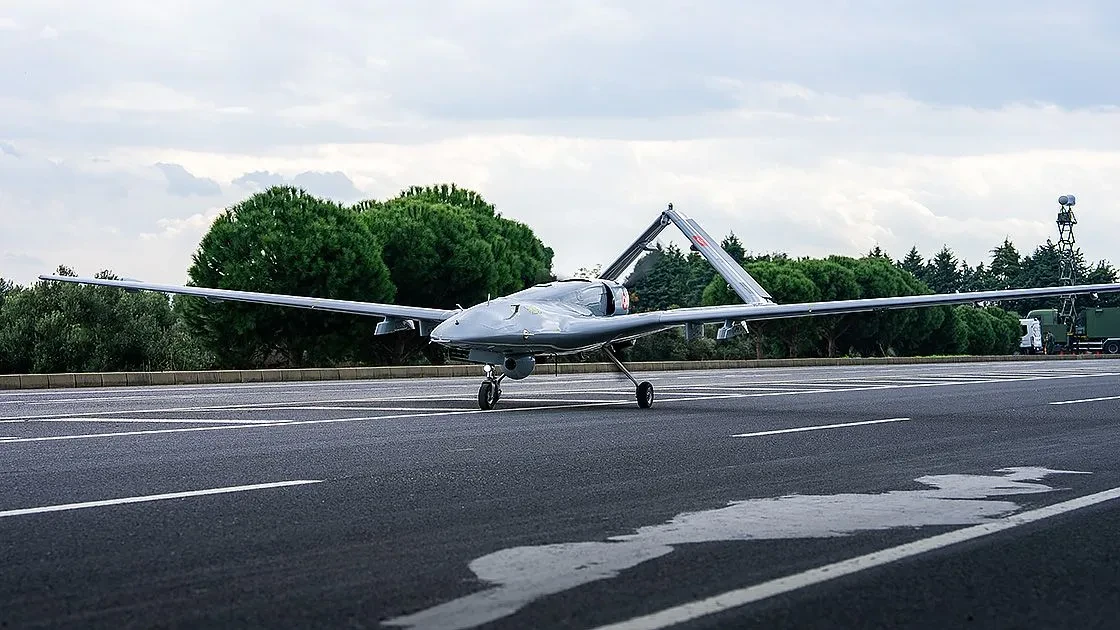
Carrying out operations aimed at emergency scenarios where runways are unavailable, the AKINCI and Bayraktar TB2 UCAVs successfully landed on and took off from the Manisa-Balıkesir Highway. Conducted under the coordination of the Ministry of National Defence, the General Directorate of Highways, and Baykar, the activity demonstrated the capability of indigenous platforms to operate independently of runways.
The first phase of field studies—initiated to ensure that unmanned aerial vehicles developed indigenously by Baykar can perform uninterrupted missions even when runways are rendered unusable—has been successfully executed. In the emergency response exercise carried out following site inspections across various regions of Turkey and designated routes, the indigenous platforms utilized the highway as a runway.
Within the scope of the exercise conducted on November 12, three indigenous aircraft taking off from different bases converged at the same point. A Bayraktar TB2—departing from Keşan and used by Baykar for training and testing activities—an AKINCI taking off from Çorlu, and another Bayraktar TB2 from the inventory of the Turkish Land Forces Command taking off from İzmir successfully performed takeoffs and landings on the Manisa-Balıkesir Highway.
Preparations for emergencies underway
The operational concept formulated within the framework of emergency response scenarios is being expanded to encompass all unmanned aerial vehicles developed by Baykar. In line with the current planning, all indigenous platforms developed by Baykar—including Turkey’s first unmanned combat aircraft, KIZILELMA, and the Bayraktar TB3, which features short-runway ship takeoff and landing capabilities—are targeted to execute takeoffs and landings from suitable highway routes without being bound to traditional runways.
Efforts are underway to enable the existing highway network to be utilized for the landing, takeoff, and stationing of unmanned aerial vehicles during disasters, emergencies, and exceptional logistic operations. In this context, 9,562 road segments meeting physical standards within the highway network were identified. From among these, a total of 52 potential road segments were designated—7 in the initial phase and 45 in the subsequent phase.
As part of these efforts, parking areas totaling 3,600 square meters were established at 3 distinct roadside points. To ensure the safe takeoff and landing of the aircraft, 5,200 meters of guardrails were removed, and 45 traffic signs were modified to be easily detachable.