
However, looking back at Russian military history reveals a third and more critical variable alongside these two: the Russian military’s capacity to learn from crises and wars. From the Napoleonic Wars and World War II to the conflicts in Afghanistan and Ukraine, Moscow’s military thought has undergone significant transformations through heavy casualties and operational failures.
As the war in Ukraine enters its fourth year, the Zapad-2026 strategic exercise can be evaluated as a contemporary manifestation of this learning and adaptation process. The exercise is not merely a show of force designed to display the current capabilities of the Russian Armed Forces, but rather a vital indicator of how operational experiences gained in the Ukrainian theater are being institutionalized within a broader doctrine and force structure.
Lessons from the War in Ukraine
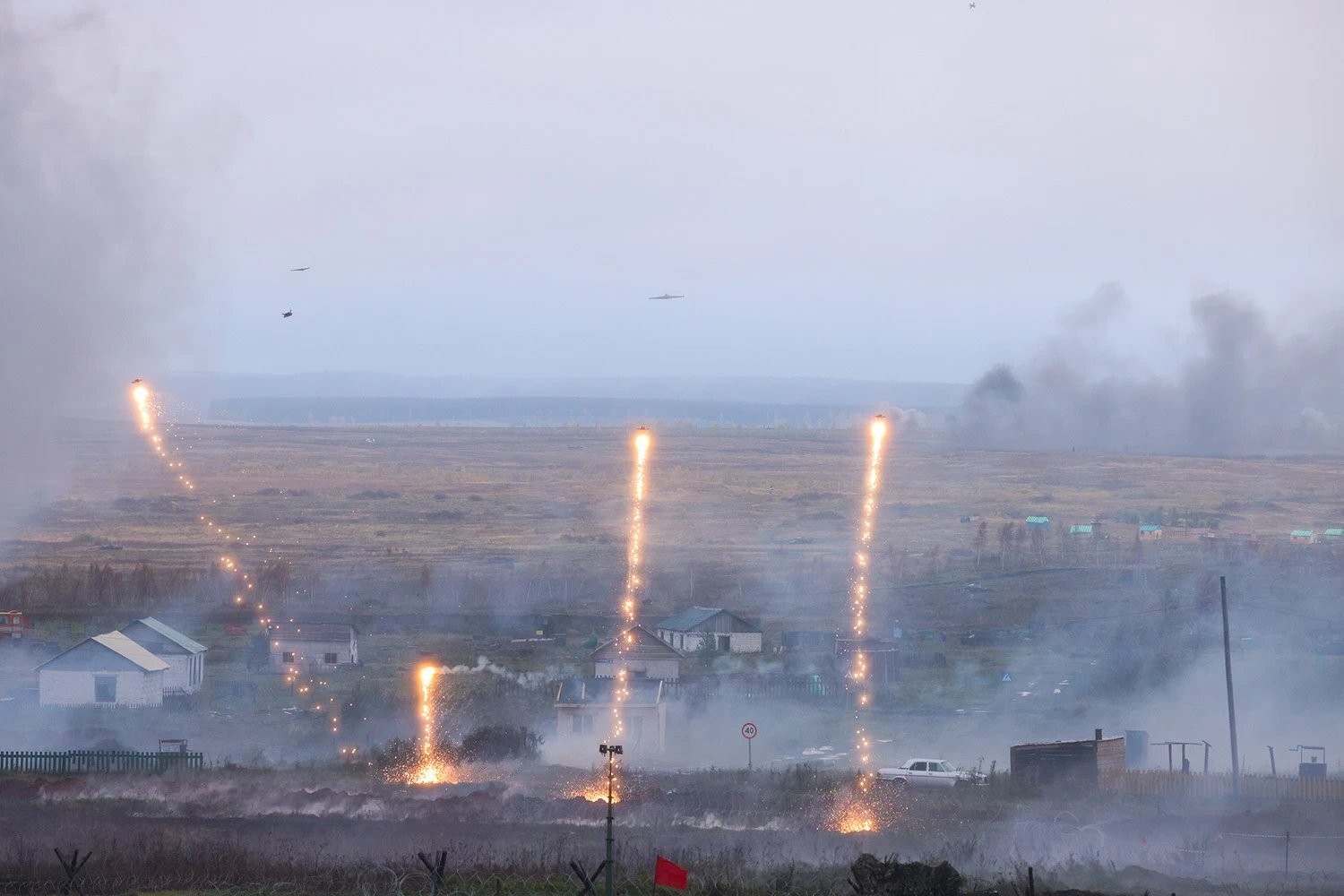
Involving over 47,000 personnel, Zapad-2026 stands out as a large-scale military activity distributed across multiple training grounds. Observed by President Vladimir Putin at the Chebarkul Training Ground, the exercise particularly highlights the integration of unmanned systems with conventional firepower.
According to official statements, approximately 6,000 personnel, 700 military vehicles and systems, over 600 unmanned aerial vehicles (UAVs), and more than 60 robotic systems participated solely at the Chebarkul range. Across the entirety of Zapad-2026, which encompassed the Caspian Sea basin and a total of 11 training grounds, more than 47,000 military personnel were reportedly deployed.
The primary element drawing attention in exercise footage is the qualitative shift in the employment of unmanned systems. Drones are no longer utilized merely as auxiliary assets providing tactical-level support to assault units; they are integrated into a broader combat architecture that operates simultaneously with armored and mechanized units, artillery elements, and other fire support systems.
Similarly, unmanned ground vehicles (UGVs) have transcended their status as experimental platforms to be deployed directly in combat missions as well as logistical operations. According to statements by the Russian military command, a significant portion of the tactics developed for robotic systems are shaped directly by combat experiences from Ukraine.
This points to a fundamental transformation in modern warfare: unmanned systems have transitioned from being secondary technologies alongside conventional military power to core components of a combined-arms combat system spanning land, air, and fire support elements.
Drone Warfare Transforms Armor and Infantry
One of the most critical military realities laid bare by the war in Ukraine is how the widespread use of First-Person View (FPV) drones severely challenges traditional troop formations.
Historically, a core tactical principle involved infantry units moving in designated density inside armored vehicles, with armored platforms providing the firepower and protection required to deliver troops to their target areas. However, the proliferation of low-cost, high-precision FPV drones has rendered such dense and predictable troop movements critically high-risk.
Consequently, decentralized structures, mobility, camouflage, speed, and small-unit tactics are gaining paramount importance on the battlefield. Armored vehicles have not lost their relevance entirely; rather, their operational methodology is evolving. Their mission has shifted from aggressively thrusting troops forward—which turns them into constant open targets—to employing firepower, protection, logistics, and maneuver capabilities within a more dispersed combat array.
The significance of Zapad-2026 lies precisely at this junction. The exercise demonstrates that the Russian military is not only applying tactical lessons learned from the conflict in Ukraine at the unit level, but is also attempting to embed them into a broader joint operations concept.
Strategic Next-Generation Platforms
Another prominent element within the scope of Zapad-2026 is Russia’s effort to diversify its long-range strike capabilities using heterogeneous platforms.
Among the more than 300 weapons and military systems presented to President Putin following the exercise, the Geran-4 and Geran-5—defined as next-generation jet-powered strike drones—drew significant attention.
According to Russian sources, the Geran-4 features a maximum speed of approximately 350 km/h, a 50-kilogram warhead, and an operational range of 750–800 kilometers. The heavier Geran-5 reportedly boasts a maximum speed of about 450 km/h, a 90-kilogram warhead, and an operational range of up to 900 kilometers.
The significance of these systems extends beyond their raw technical specifications. The core issue is the potential deployment of high-speed, long-range unmanned platforms alongside classical cruise missiles and ballistic systems within more complex, multi-layered strike concepts.
Therefore, Zapad-2026 is significant because it indicates that the Russian military is not merely attempting to manufacture drones in higher volumes, but is actively constructing a combat ecosystem that integrates drones with artillery, electronic warfare, armored units, reconnaissance-surveillance elements, and long-range fire systems.
The Significance of Russian Military Transformation
The picture painted by Zapad-2026 indicates that the impact of the war in Ukraine on Russian military thought extends far beyond the tactical level. Four years of conflict have forced the Russian military to adapt to the ubiquity of unmanned systems, precision firepower, continuous reconnaissance-surveillance, and dispersed combat layouts.
Consequently, evaluating the exercise merely as a military parade or a quantitative display of power would be incomplete. Zapad-2026 can be interpreted as an operational rehearsal of a new art of war, characterized by the deep integration of high-intensity conventional warfare with robotic and unmanned systems.
Here, a broader paradox of Russian military history emerges. The Russian military may encounter severe vulnerabilities, coordination issues, and heavy casualties during the initial phases of wars; however, as conflicts drag on, it demonstrates a substantial adaptive capacity to translate battlefield experience into doctrine, organization, and weapon systems.
Therefore, assessing Russia’s military capacity by looking solely at its initial performance is insufficient. The real issue lies in how quickly the Russian military learns during wartime, the extent to which it institutionalizes those lessons, and its ability to translate this learning into a novel force structure.
Indeed, one of the most critical military observations of World War II is encapsulated in a remark attributed to Winston Churchill:
"It is the Red Army that devours the guts of the German army."
This statement highlights the fundamental paradox of Russian military history. The Red Army suffered heavy casualties and experienced massive operational and command failures at the onset of the war, yet transformed by the end of the conflict into one of the world's most experienced land forces.
The transformation observed today in the context of the war in Ukraine can be addressed as a modern iteration of this historical pattern. The true significance of Zapad-2026 lies not in the sheer volume of weaponry Russia possesses, but in what the war has taught the Russian military and how Moscow is channeling these lessons into the warfare of tomorrow.
Perhaps for this reason, understanding Russian military power requires looking beyond the famous Russian adage regarding "roads and fools," and examining the experience, adaptation, and learning capacity that warfare has instilled in the Russian armed forces.